I have always been drawn to peacocks - well, specifically their colours. In my studio (on which I hand-painted a peacock on the outside wall), hangs a single peacock feather that has been in my life since I was a teenager. The iridescence of its colours never fails to enchant me and has been the inspiration for quite a few creative pieces over the years.
With plenty of the deep olive warp still on my loom (see previous post), I set out to select an array of colours which would drift across the surface of a plain weave, constantly change their relationships to each other and be a woven reminder of my favourite peacock feather.
Selecting yarns from my stash is always for me like mixing paints, so I pulled out an array of silvery-sea greens, golden oranges and coppery bronze yarns to add to the purple I was already using in the weft.
Twisted fringes finished it off, and after a gentle wash and steam, it's already had its first autumn outing in early April. I know there's not really any purple peacocks, but .......... wouldn't they be fabulous!
Tuesday, April 9, 2013
Saturday, April 6, 2013
The Next Challenge
I have a long history of never taking the easy road in anything I do. To make sure my brain and my skills are stretched yet once again, I decided to find a way to weave a wavy design (continual S curves) along the length of a fabric. This search brought me to network drafted advancing twills. Now, I can understand each of those words in isolation, but as a phrase, that was another thing altogether!!
Reading and re-reading (more than a couple of times) an indepth article on WeaveZine by Bonnie Inouye titled: Flowing Curves: Network Drafted Twill. I discovered how to do what I wanted on my table loom with six shafts. I took me quite a while to work out the process and I sure don't fully understand how to design my own weaving drafts, but I got to work deciphering the information. Bonnie is a highly experience weaver, so I was worried I may have been way out of my depth.
This meant a 42-thread repeat on the warp threading and a 100 pick (row) repeat in the weft weaving. And in between each of these pattern picks, were alternate odd & even tabby (plain) rows. Attention to detail at every level and step of the way was paramount to the success of this weave structure and design, but I was determined.
It's now complete. A 2 metre scarf using a deep olive warp with purple and seafoam green weft. The set was possibly a little coarse and using finer yarns would have defined the pattern more, but it has a lovely soft drape. Once I got the hang of it, it was however quote boring to actually weave. I wasn't making moment by moment decisions about colours and different yarns and textures and all the things I really enjoy about weaving! By following this weave pattern to the absolute letter (essential for the outcome), I became an extension of the loom. This process has produced a fine looking scarf, but without the personal input to design. To me, it doesn't have the life and energy that I bring to my art weaving.
Tiring of the repetitious weaving and abandoning the advancing twill pattern, I went on to have a bit more fun with a short scarf, introducing a multi-coloured yarn along with some silvery highlights. Just because I could!
Because I put on a 6 metre warp, I plan to move on to another 2 metre length which uses simple tabby weave BUT represents something much more, with use of different colours, yarns and their ever changing interactions.............
my next post will explore the outcome of that adventure!
Reading and re-reading (more than a couple of times) an indepth article on WeaveZine by Bonnie Inouye titled: Flowing Curves: Network Drafted Twill. I discovered how to do what I wanted on my table loom with six shafts. I took me quite a while to work out the process and I sure don't fully understand how to design my own weaving drafts, but I got to work deciphering the information. Bonnie is a highly experience weaver, so I was worried I may have been way out of my depth.
This meant a 42-thread repeat on the warp threading and a 100 pick (row) repeat in the weft weaving. And in between each of these pattern picks, were alternate odd & even tabby (plain) rows. Attention to detail at every level and step of the way was paramount to the success of this weave structure and design, but I was determined.
It's now complete. A 2 metre scarf using a deep olive warp with purple and seafoam green weft. The set was possibly a little coarse and using finer yarns would have defined the pattern more, but it has a lovely soft drape. Once I got the hang of it, it was however quote boring to actually weave. I wasn't making moment by moment decisions about colours and different yarns and textures and all the things I really enjoy about weaving! By following this weave pattern to the absolute letter (essential for the outcome), I became an extension of the loom. This process has produced a fine looking scarf, but without the personal input to design. To me, it doesn't have the life and energy that I bring to my art weaving.
Tiring of the repetitious weaving and abandoning the advancing twill pattern, I went on to have a bit more fun with a short scarf, introducing a multi-coloured yarn along with some silvery highlights. Just because I could!
Because I put on a 6 metre warp, I plan to move on to another 2 metre length which uses simple tabby weave BUT represents something much more, with use of different colours, yarns and their ever changing interactions.............
my next post will explore the outcome of that adventure!
Thursday, February 14, 2013
Metamorphis: cloth to couture
My very first hand-woven cloth transformed into a hand-made couture garment!
Inspired by Japanese design, informed by patterns in a wonderful Saori design book, here is my first garment. The weaving referencing the tidal sea and sands, the garment constructed using the entire finished woven cloth, with minimal cutting and not one scrap of wastage!
I purchased the book Fuku no Katachi ni Suru (or How to make clothes with SAORI cloth) in Japanese from Kaz Madigan at http://curiousweaver.id.au a few months ago. Pouring over the images and pattern diagrams (not even attemting to read the Japanese text), gave me lots of ideas for construction of a range of garments using the whole cloth. With their sizing based on a "typical" woman of 163cm (I am 170cm) I figured that using a wider weave would take care of fit and proceeded to weave my piece at 50cm wide x 300cm in length. After washing and pressing, the finished dimensions were 45cm x 280cm - which proved how essential this step was BEFORE finalising the pattern measurements!
Having sewn since I was 14 years old has given me a good grounding in garment construction, yet I first set to work to make a toile from some old fabric. Never having pieced together simple rectangles of fabric previously, I wanted to make sure the reality matched the theory. It worked! I then adjusted the proportions of my pattern pieces to utilise the entire piece of my hand-woven fabric.
Constructing the jacket, which I discovered with delight, can be worn in several distinct styling variations, was simplicity itself. I would love to know what you think of my Silken Sands garment?
Inspired by Japanese design, informed by patterns in a wonderful Saori design book, here is my first garment. The weaving referencing the tidal sea and sands, the garment constructed using the entire finished woven cloth, with minimal cutting and not one scrap of wastage!
I purchased the book Fuku no Katachi ni Suru (or How to make clothes with SAORI cloth) in Japanese from Kaz Madigan at http://curiousweaver.id.au a few months ago. Pouring over the images and pattern diagrams (not even attemting to read the Japanese text), gave me lots of ideas for construction of a range of garments using the whole cloth. With their sizing based on a "typical" woman of 163cm (I am 170cm) I figured that using a wider weave would take care of fit and proceeded to weave my piece at 50cm wide x 300cm in length. After washing and pressing, the finished dimensions were 45cm x 280cm - which proved how essential this step was BEFORE finalising the pattern measurements!
Having sewn since I was 14 years old has given me a good grounding in garment construction, yet I first set to work to make a toile from some old fabric. Never having pieced together simple rectangles of fabric previously, I wanted to make sure the reality matched the theory. It worked! I then adjusted the proportions of my pattern pieces to utilise the entire piece of my hand-woven fabric.
.jpg)
Constructing the jacket, which I discovered with delight, can be worn in several distinct styling variations, was simplicity itself. I would love to know what you think of my Silken Sands garment?
Labels:
cloth,
couture,
hand woven,
jacket,
Saori,
weaving,
zero waste
Monday, January 28, 2013
Silken Sands
I began this weaving with loose ideas and concepts. After an overload of planning and documentation in past months, I wanted to weave a summer fabric in silk and cotton allowing intuition to be my main guide.
Commencing with the natural silk/cotton blend warp and the same yarn in the weft, I gradually introduced a natural raw silk, a hand dyed blue softly spun silk, and yet another raw silk (also dyed blue). To add some energy and contrast to this softness, I had to include a wonderful multicoloured yarn sourced from the Linton Mills in the UK in 2011. Varying the beat, using two shuttles and two sticks at times, this weaving continues to grow and speaks to me of the soft colours of silken beach sands and seaweed.
Having now just returned from a few restful days at Port Albert (Gippsland's oldest port), and after a long trek around the shores of the nearby Nooramunga Coastal & Marine Park, I was surprised to see how the colours of the tidal beaches there echoed the colours in my weaving begun two weeks before this visit. I was also delighted to see a recent post by Curiousweaver http://curiousweaver.id.au/ about her recent seaweed weaving experiment!
As a non-swimmer with a fair Irish-Anglo complexion, beaches are not usually a place where I spend much time. So my colours are not of typical Australian sunny, hot beaches, but rather of softer shades, where different blues and greens meet and move across the sandbars.
Another strong image on this walk, that may well appear in future weaving, was the large number of huge banksia trees. I had never seen so many banksia in one place and was intrigued by their twisted forms, their large soft yellow flowers in full bloom and the myriad of fallen dark eyed banksia cones.
Commencing with the natural silk/cotton blend warp and the same yarn in the weft, I gradually introduced a natural raw silk, a hand dyed blue softly spun silk, and yet another raw silk (also dyed blue). To add some energy and contrast to this softness, I had to include a wonderful multicoloured yarn sourced from the Linton Mills in the UK in 2011. Varying the beat, using two shuttles and two sticks at times, this weaving continues to grow and speaks to me of the soft colours of silken beach sands and seaweed.
Having now just returned from a few restful days at Port Albert (Gippsland's oldest port), and after a long trek around the shores of the nearby Nooramunga Coastal & Marine Park, I was surprised to see how the colours of the tidal beaches there echoed the colours in my weaving begun two weeks before this visit. I was also delighted to see a recent post by Curiousweaver http://curiousweaver.id.au/ about her recent seaweed weaving experiment!
As a non-swimmer with a fair Irish-Anglo complexion, beaches are not usually a place where I spend much time. So my colours are not of typical Australian sunny, hot beaches, but rather of softer shades, where different blues and greens meet and move across the sandbars.
Beach at Nooramunga Coastal & Marine Park, Port Albert, Victoria
Sunday, January 13, 2013
Weaver to Weaver
Back in early December, Meg http://www.megweaves.co.nz/ proposed a way of connecting with other weavers around the globe and sharing some "weaverly love". I signed up for this and sent off two little packets of inspiration to weavers in New Zealand and USA, neither of whom I have ever met. The next step was waiting for a couple of packets to arrive from others, all of us assigned names randomly.
I had been wondering who would be sending me some weaverly love and excited about the possibility of some new weaving friendships. With the new year off to a start, I was delighted to receive the two envelopes over the past couple of weeks.
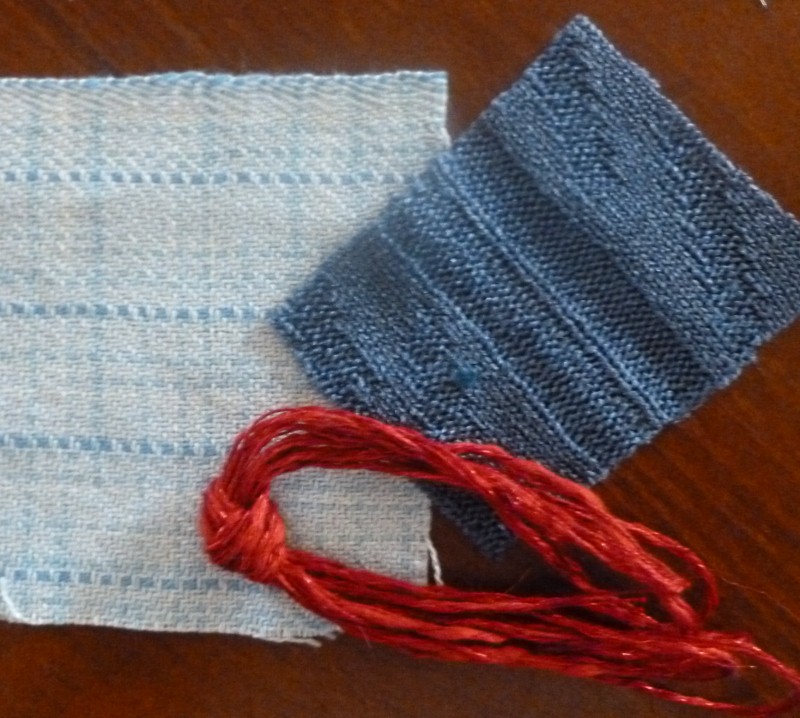
The first one, from Helen, filled with inspiring images and pieces of her own weaving. She is a long way ahead of me in weaving experience and her letter was filled with the wonderful details of her 2012 weaving year. Truly inspiring and as she just so happens to live nearby, we may actually meet up in person to share even more. One can never have enough weaving friends!
I had been wondering who would be sending me some weaverly love and excited about the possibility of some new weaving friendships. With the new year off to a start, I was delighted to receive the two envelopes over the past couple of weeks.
The first one, from Helen, filled with inspiring images and pieces of her own weaving. She is a long way ahead of me in weaving experience and her letter was filled with the wonderful details of her 2012 weaving year. Truly inspiring and as she just so happens to live nearby, we may actually meet up in person to share even more. One can never have enough weaving friends!
![]() |
| Close up of Helen's yarn & handwoven fabric samples |
My second package arrived today from Jane in the UK. Inside was a copy of an exquisite painting done by a friend of hers (http://www.amandapellatt.co.uk), based on Jane's Chinese moon moths. Apparently Jane raises these moths from silk worms. She also included some lovely hand dyed silk yarn in soft greens and rose. Jane is an experienced textile artist and tutor, and you can read more about her at http://www.janedeane.co.uk/ Thank you Jane!
With comparitavely so little hand weaving in Australia, it is exciting for me to meet up with other weavers, even if by long distance. There is ALWAYS something new to admire, learn and be inspired by. Thank you Meg for initiating Weaver to Weaver!
Thursday, December 27, 2012
BAREFOOT weaving
With my looms currently empty and awaiting a new warp, I had planned to get onto a new weaving before the end of 2012. However, currently laid low with a severe throat infection since Boxing Day, means it will be 2013 before I trust both my brain and body to go through the complexity that is the warping process again!
However, weaving and woven textiles are still close at hand, with my son's gift of a wonderful new woven tapestry from weaver Marie Gnarajah of the BAREFOOT weaving studion in Sri Lanka. This weaving is 1700cm x 900cm and will be hung in my family room (opposite my floor loom), the colours perfectly complimenting the decor.
A few months ago he also brought back from his visit to their studio in Colombo, two lengths of fabulous warp faced heavy cloth. One has already been in use as a perfectly sized tablecloth for my rather large family table and the other (pictured below) currently draped across the back of a sofa as I cannot bear to cut it. Simply constructed in plain weave, but the use of colour is superb, with each piece of cloth imbued with an energy that only handweaving brings to cloth making.
BAREFOOT began over 40 years ago when Barbara Sansoni was invited to design cloth for women learning to weave in a convent workshop North of Colombo, Sri Lanka.
Today the company she founded has a small team of dedicated designers who work with our own dyers, weavers and skilled needle women. Take a look at http://barefootceylon.com/ to see something of the beauty that is BAREFOOT.
![]() |
| Portion of woven tapestry by Marie Gnarajah |
A few months ago he also brought back from his visit to their studio in Colombo, two lengths of fabulous warp faced heavy cloth. One has already been in use as a perfectly sized tablecloth for my rather large family table and the other (pictured below) currently draped across the back of a sofa as I cannot bear to cut it. Simply constructed in plain weave, but the use of colour is superb, with each piece of cloth imbued with an energy that only handweaving brings to cloth making.
BAREFOOT began over 40 years ago when Barbara Sansoni was invited to design cloth for women learning to weave in a convent workshop North of Colombo, Sri Lanka.
Today the company she founded has a small team of dedicated designers who work with our own dyers, weavers and skilled needle women. Take a look at http://barefootceylon.com/ to see something of the beauty that is BAREFOOT.
Labels:
Barefoot,
cloth,
Colombo,
colour,
plain,
Sri Lanka,
tabby,
tapestry,
warp faced weave,
weaving
Wednesday, December 5, 2012
Weaving a Life
Weaving a life
with threads of glass;
fragile and sharp
they can cut you.
Reflecting a world
of beauty and pain;
the warp of years
the weft of experience.
Weaving a life
with threads of song;
joyous release
it can free you.
Harmonies of love and sorrow;
the warp of years
the weft of experience.
H.Walters 2011
I wrote this poem last New Year's Eve - clearly in a deeply contemplative mood at the time! With my mother's 80th birthday approaching I have reflected on her life. Her lack of options for education, her entire adult life marred by illness, repeated surgery and long periods of hospitalisation.
Her indirect influence on my life has been conversely to value education, value independent thinking, question everything and value creativity. My gift to her is to weave a summer silk wrap, combining a strict weave structure with free form Saori type weaving. Somewhat of a metaphor for our contrasting approaches to life!
This wrap comprises my first attempts at a leno weave, my first use of a silk warp and weft and using the maximum width on this loom at 45cm. The finished length of the wrap is 185cm plus 18cm fringes at both ends.
As I wove, I made conscious moment by moment choices about changing the weave structure, adding silk fibre, changing the beat and skipping some warp threads. Struggling with uneven warp threads due to my uneven beaming, meant I had to constantly add weights to parts of the warp. It sure wasn't smooth sailing! Rather like our lives.
It is now off the loom, hemstitched, washed to see settle the silk yarns into their new life, twisted fringes done and ready to give to my mother. With my love woven in, even if I cannot say the words.
Her indirect influence on my life has been conversely to value education, value independent thinking, question everything and value creativity. My gift to her is to weave a summer silk wrap, combining a strict weave structure with free form Saori type weaving. Somewhat of a metaphor for our contrasting approaches to life!
This wrap comprises my first attempts at a leno weave, my first use of a silk warp and weft and using the maximum width on this loom at 45cm. The finished length of the wrap is 185cm plus 18cm fringes at both ends.
It is now off the loom, hemstitched, washed to see settle the silk yarns into their new life, twisted fringes done and ready to give to my mother. With my love woven in, even if I cannot say the words.
Subscribe to:
Posts (Atom)
.jpg)
.jpg)
.jpg)
.jpg)
.jpg)
.jpg)
.jpg)
.jpg)
.jpg)
.jpg)
.jpg)
.jpg)
.jpg)
.jpg)
.jpg)
.jpg)
.jpg)
.jpg)
.jpg)
.jpg)

.jpg)
.jpg)
.jpg)
.jpg)
.jpg)
.jpg)
.jpg)
.jpg)
.jpg)
.jpg)
.jpg)
.jpg)